Adopting automated cleaning equipment, especially in the field of precision manufacturing, is by no means simple "replacement of human labor with machines," but rather a comprehensive, systemic upgrade across **"process, management, and quality."** Its advantages far exceed mere efficiency improvement and can be summarized into the following levels:
| Advantage Dimension | Specific Manifestation and Value |
| 1. Efficiency and Capacity Revolution | Continuous Production: Runs 24/7 without human intervention. Fixed Cycle Time: Production cycle is stable and predictable, facilitating production planning. High Throughput: Large single batch capacity, overall capacity increases exponentially. |
| 2. Leap in Quality Consistency | Eliminates Human Fluctuation: Process parameters (time, temperature, force) are absolutely consistent every time. "Zero Contact" Assurance: Avoids human contact throughout the process, eliminating secondary contamination, scratches, or fingerprints. Reduces Defect Rate: Stable process directly leads to a significant increase in product qualification rate. |
| 3. Deep Optimization of Full-Process Cost | Sharp Reduction in Direct Labor: In the long run, the proportion of labor costs drops significantly. Precise Material Control: Accurately controls the consumption of cleaning agents, water, and gas, reducing waste. Reduced Quality Cost: Costs associated with rework, scrap, and customer complaints due to poor cleaning drop sharply. |
| 4. Systemic Assurance of Safety and Environment | Isolation from High-Risk Operations: Personnel are kept completely away from hazardous environments such as high temperature, chemicals, and noise (relevant to your concern regarding flammable solvent protection). Environmental Compliance: Closed systems reduce volatility, and concentrated waste liquid treatment is more standardized. |
| 5. Intelligent Production Mode and Management | Traceability: Every batch of products has complete process data records (time, parameters), meeting traceability requirements. Seamless Integration: Easily connects to MES/ERP systems, becoming a part of the smart factory. Data-Driven Decisions: Continuous process optimization and predictive maintenance through analysis of operational data. |
How to achieve a qualitative change in quality and process?
Automated cleaning provides a systemic solution to address the "consistency" and "stability" issues you previously focused on. Its core process design ensures the predictability of results:
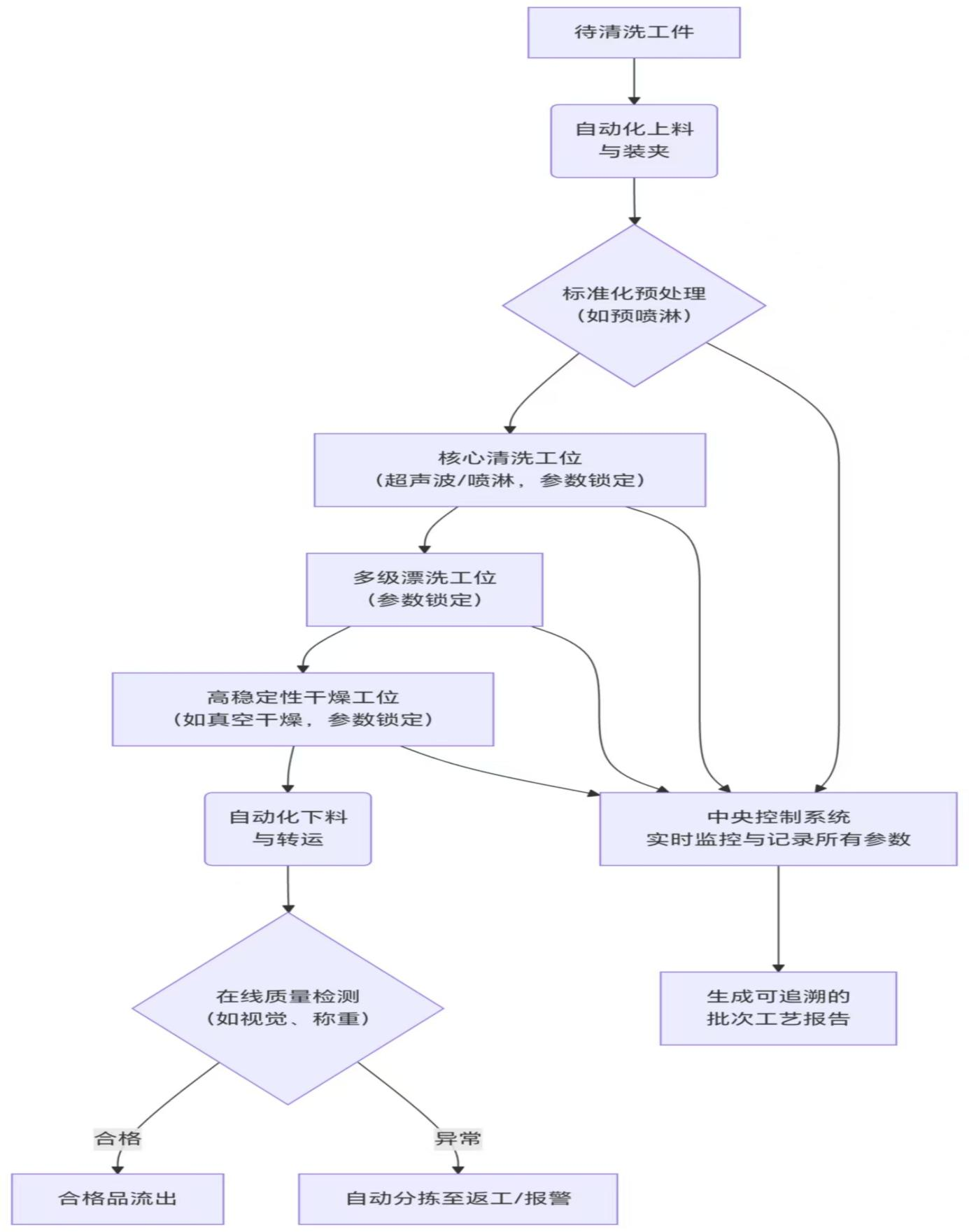
Automation's core advantage is that it transforms a set of discrete "operational steps" that rely on human experience into a "manufacturing system" that is precisely controllable, repeatedly verifiable, continuously optimizable, and data-driven.
For the precision cleaning field, this means:
1. Quality Barrier: Establishes a stable, high-quality standard that competitors find difficult to replicate manually.
2. Cost Restructuring: Shifts the cost focus from variable human labor costs to predictable and optimizable equipment and energy consumption costs.
3. Safety Upgrade: Completely frees personnel from dangerous and tedious tasks, achieving intrinsic safety.
Summary: The return on investment for automated cleaning is directly related to product volume, standardization level, and cleanliness requirements. It is recommended to start planning and validation with the product lines that are "most mature in process, most prominent in problems, and largest in output volume."